Open-Source Intelligence (OSINT)—the strategic craft of finding “needles” in the public data haystack—has undergone a fundamental shift. In 2026, we are no longer limited by the speed of manual “Google Dorking” or the painstaking review of social media profiles. The sheer volume of digital exhaust produced by modern life has surpassed human cognitive capacity, making Artificial Intelligence not just a luxury, but the primary engine of modern investigation.
How AI is Redefining “Public” Intelligence
The transition from manual searching to automated synthesis is driven by three technological breakthroughs:
1. Pattern Recognition at Scale (De-anonymization)
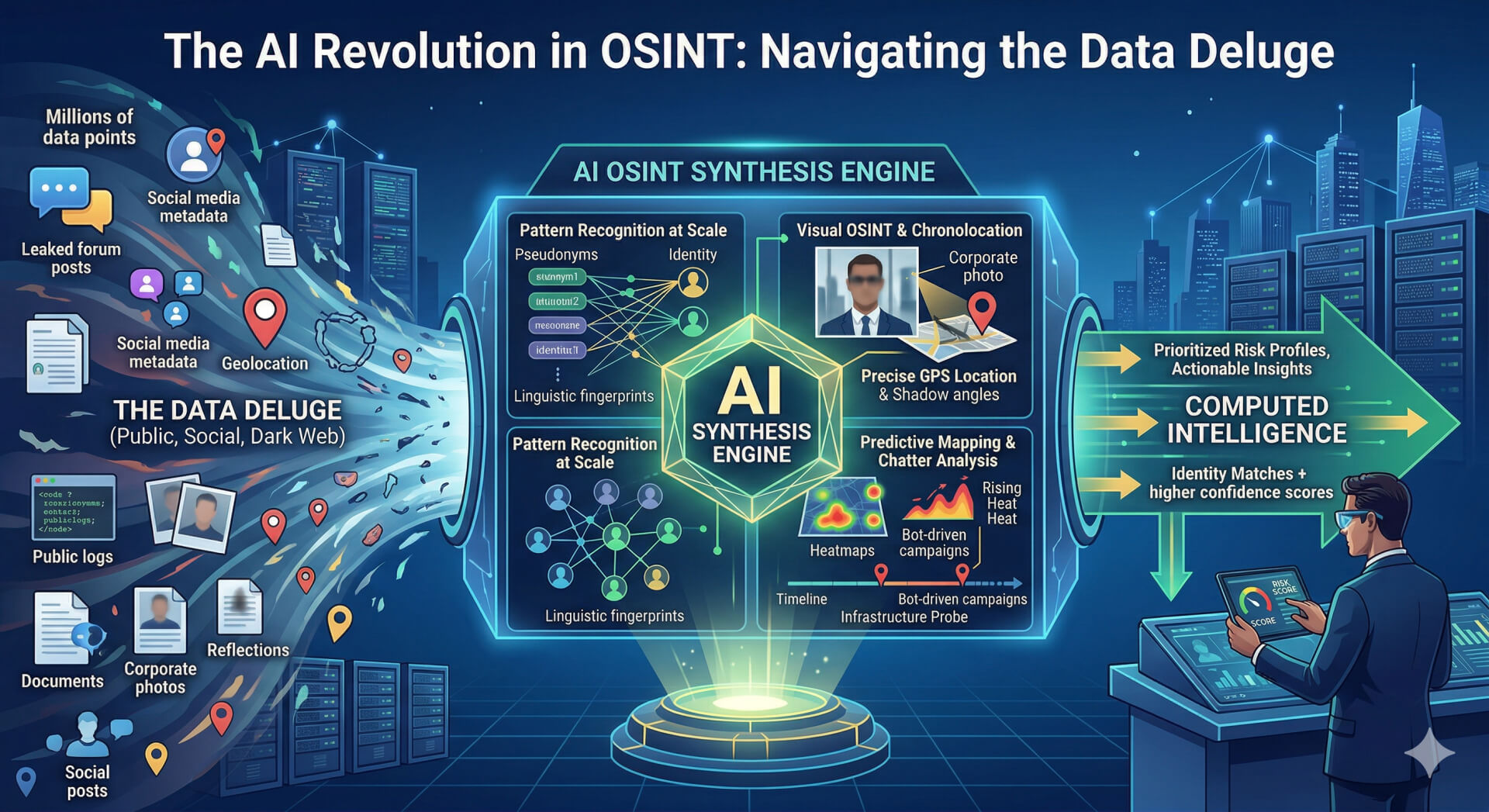
One of the most disruptive shifts in 2026 is the ability of Large Language Models (LLMs) to perform at-scale de-anonymization. Research from institutions like ETH Zurich has proven that AI can now ingest millions of leaked forum posts, metadata, and technical logs to find “stylometric fingerprints.”
By analyzing unique linguistic quirks, interests, and incidental disclosures, AI can match a pseudonymous account on a platform like Reddit to a real-world identity on LinkedIn with startling precision—even when all direct identifiers have been stripped.
2. Visual OSINT and Environmental Intelligence
Visual investigations have moved beyond simple reverse-image searches. Advanced Computer Vision (CV) and Vision Transformers (ViTs) now treat images as structured data.
-
Reflection Analysis: AI can analyze a background reflection in a window or a laptop screen to reconstruct a room’s layout.
-
Geo-Temporal Mapping: Tools can automatically calculate the exact GPS coordinates and time of day of a photo by analyzing shadow angles (chronolocation) and local architectural features.
-
Object Forensics: Computer vision can identify specific models of hardware or sensitive documents left visible on a desk, often identifying “leak” sources before the human eye even registers the background detail.
3. Predictive Mapping and Chatter Analysis
The most advanced OSINT units now focus on Predictive Targeting. By monitoring “chatter” across decentralized platforms (like Mastodon or specialized Telegram nodes) and the Dark Web, AI-driven sentiment analysis can detect the “rising heat” of a coordinated attack.
-
Anomaly Detection: AI identifies non-human “sleep cycles” and posting frequencies to flag bot-driven influence campaigns.
-
Threat Forecasting: By correlating historical breach data with current forum discussions, systems can predict which infrastructure an attacker is likely to probe next, allowing for proactive defense rather than reactive patching.
The Bottom Line
In 2026, the competitive edge for a security analyst lies in their ability to act as a human-in-the-loop for an AI-powered engine. OSINT is no longer just about searching for information; it’s about synthesizing disparate data points into a coherent threat picture. In the modern era, the best intelligence isn’t found—it’s computed