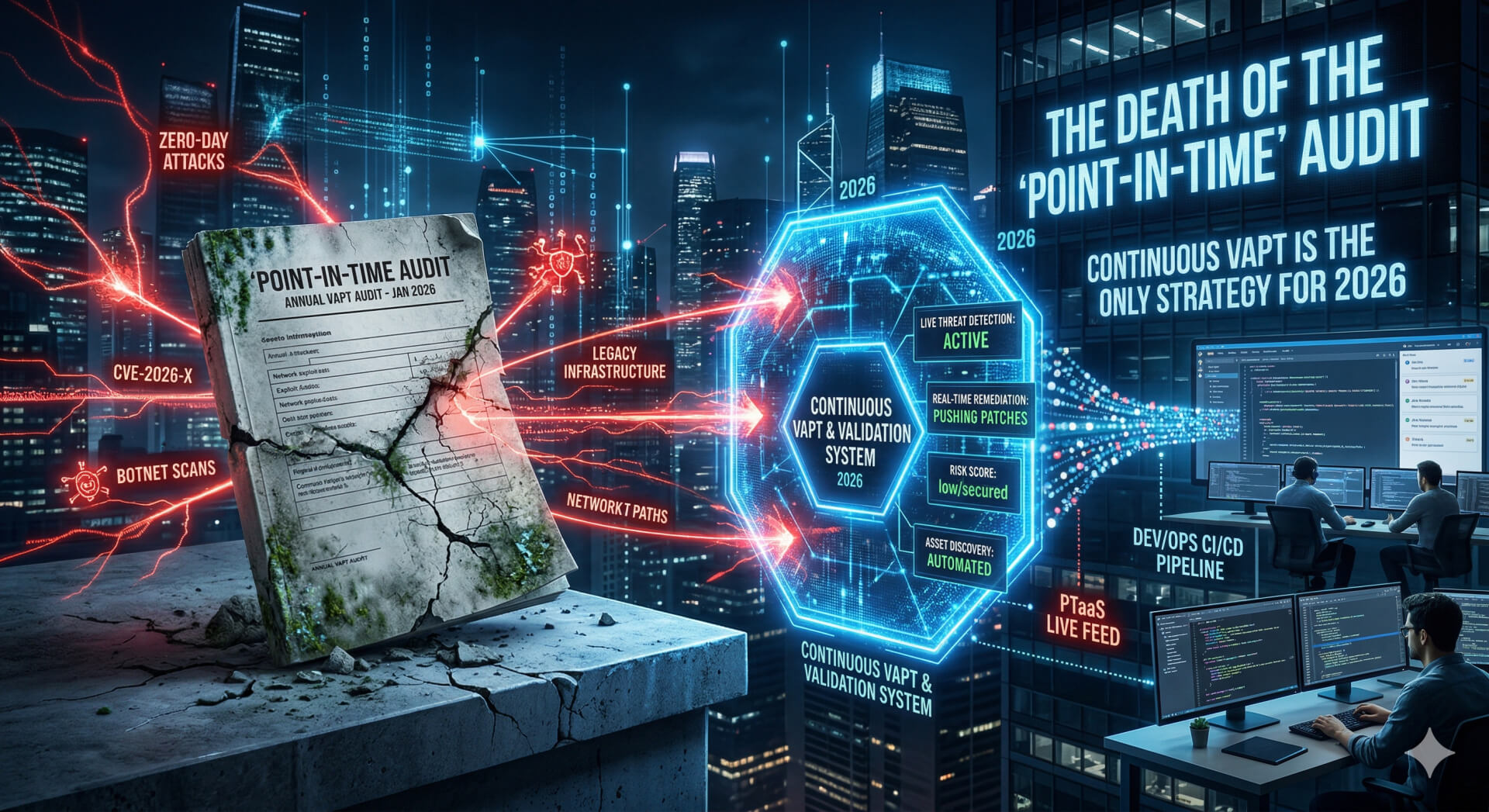
For decades, the standard operating procedure for Cybersecurity was predictable: you built your defenses, and once a year, you hired a specialized firm to try and break them. This Vulnerability Assessment and Penetration Testing (VAPT) “annual physical” was the gold standard for compliance and peace of mind.
But in 2026, that strategy is more than just outdated—it’s a dangerous delusion.
As digital infrastructures have shifted from static servers to fluid, AI-driven cloud ecosystems, the “once-a-year” audit has become the digital equivalent of checking your smoke detector batteries once a decade while living in a lightning storm. For the modern C-Suite, the transition from periodic testing to Continuous Security Validation isn’t just a technical upgrade; it’s a survival requirement.
The Velocity of the Modern Threat Landscape
The primary driver behind this shift is the sheer speed of exploitation. In the early 2020s, a “fast” exploit might take days or weeks to circulate after a vulnerability was disclosed. Today, the timeline has collapsed into minutes.
When a new Zero-Day vulnerability is announced in 2026, global botnets powered by autonomous AI agents begin scanning the entire IPv4 and IPv6 space for that specific flaw in under 15 minutes. If your organization relies on a penetration test that was conducted six months ago, you are defending a 2026 network with a map that belongs in a museum.
Modern threats don’t wait for your budget cycle. They capitalize on the “Security Gap”—the period between when a vulnerability is introduced (via a new code deploy or a configuration change) and when it is finally discovered by a human auditor.
The Evolution: VA vs. PT in the Continuous Era
To understand the 2026 strategy, we must redefine what Vulnerability Assessment (VA) and Penetration Testing (PT) actually look like in a high-velocity environment.
1. The Constant Heartbeat: Automated VA
Vulnerability Assessment is no longer a scheduled scan that bogs down your network on a Sunday night. In 2026, VA is an integrated “heartbeat.”
-
Infrastructure as Code (IaC) Integration: Scans happen during the build phase. If a developer accidentally opens a port or misconfigures an S3 bucket, the “VA” flags it before the code even reaches production.
-
Asset Discovery: With the explosion of microservices and IoT, you can’t protect what you don’t know exists. Modern VA tools use machine learning to constantly discover “shadow IT” and bring it under the security umbrella in real-time.
2. The Agile Strike: Pentesting as a Service (PTaaS)
Pentesting has historically been hampered by its delivery method: the dreaded 100-page PDF. By the time a CISO reads a traditional report, the findings are often three weeks old, and the environment has already changed.
-
Real-Time Remediation: PTaaS platforms now provide a live feed of findings. As a human pentester finds a logic flaw or a complex exploit chain, it appears instantly on the engineering team’s dashboard.
-
The Hybrid Model: While AI handles the “low-hanging fruit” (SQL injections, known CVEs), human ingenuity is reserved for what machines still struggle with: business logic errors and creative social engineering.
The Strategic Shift: From “Compliance” to “Resilience”
Why are some organizations still clinging to the annual model? Often, it’s because of a legacy focus on compliance. Regulators used to only ask for an “annual report.”
However, in 2026, regulators (and insurance providers) have caught on. They now look for evidence of remediation. A “clean” report from ten months ago is no longer proof of security; it is proof of stagnation.
Continuous VAPT provides three strategic advantages:
-
Lower Remediation Costs: Fixing a bug the hour it’s introduced is significantly cheaper than refactoring an entire system months later during an audit.
-
Developer Empowerment: By integrating security findings into the tools developers already use (Jira, Slack, GitHub), security ceases to be a “blocker” and becomes a quality-control metric.
-
Risk Quantization: CISOs can now provide the board with a real-time “Risk Score” based on live data, rather than an educated guess based on last year’s performance.
The Bottom Line
VAPT is no longer a certificate you hang on the wall to satisfy an auditor; it is a continuous feedback loop that ensures your defenses actually work against human-led ingenuity and machine-led speed.
In 2026, the question is no longer “Did we pass our audit?” The question is “Are we secure right now?” If your VAPT strategy can’t answer that, it’s time to stop looking at the calendar and start looking at the clock.